




Project Management Perspectives — Part 4 of 5
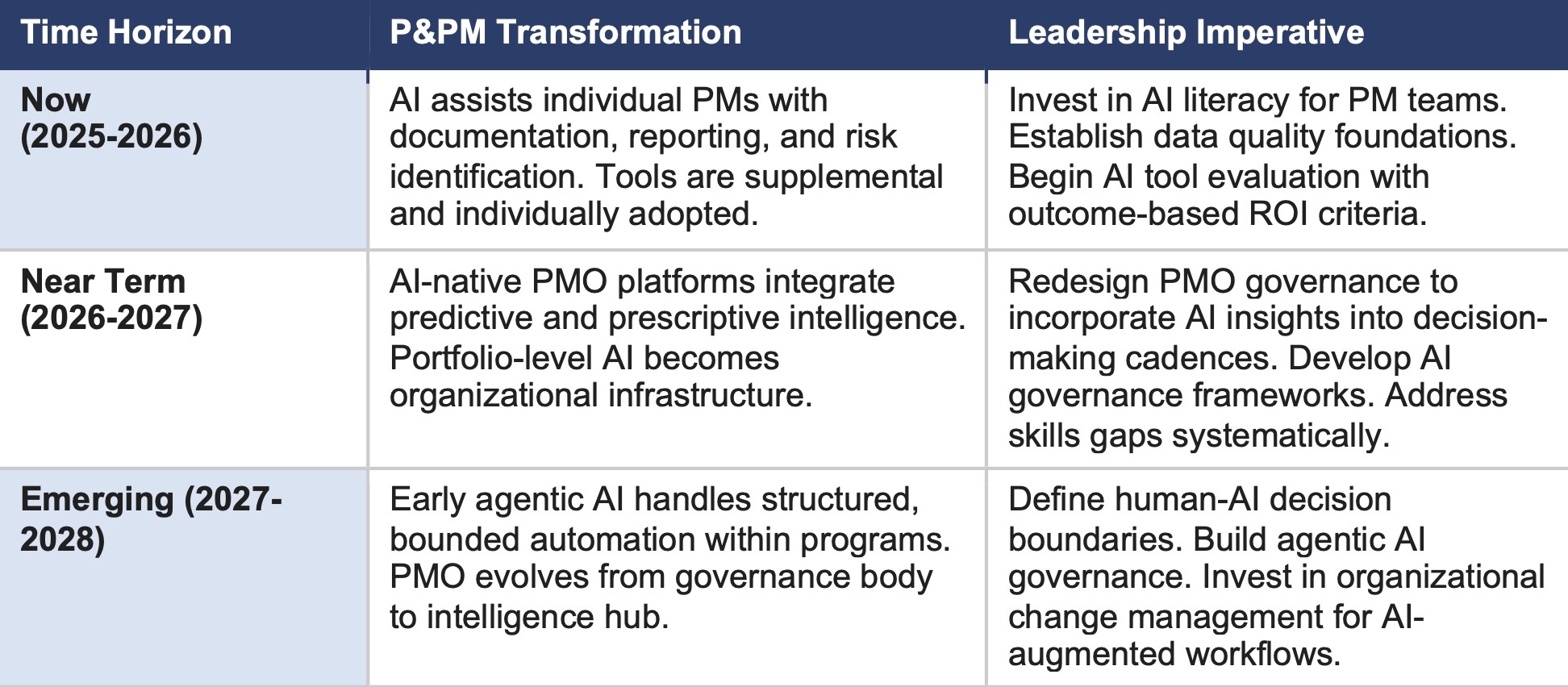
The next three years will see AI transition from a productivity tool used by individual project managers to an embedded intelligence layer woven into the organizational architecture of the Project Management Office itself. This transition — from AI as personal assistant to AI as institutional capability — is the defining P&PM development of the 2026–2028 period. Understanding it clearly is essential for any organization invested in building and sustaining IT program delivery excellence.
Predictive Intelligence Becomes Standard Infrastructure
By 2028, the distinction between organizations that use AI-driven predictive analytics in their PMO and those that do not will be comparable to the distinction that existed a decade ago between organizations with formalized risk registers and those without. What is today an advanced capability will be standard infrastructure.
This shift will be enabled by the maturation of AI-native project management platforms that integrate predictive intelligence directly into the project lifecycle — not as an add-on module, but as a foundational layer that continuously analyzes program health, resource demand, risk exposure, and benefit realization against organizational baselines. The Capterra 2025 survey already shows this trend clearly: 55% of PM tool purchases were AI-triggered, signaling that the market is moving decisively toward AI-native platforms.
For IT program management specifically, predictive intelligence will shift from forecast-oriented (predicting outcomes based on historical patterns) to prescriptive (recommending specific corrective actions with confidence-weighted outcomes). A PMO operating on prescriptive AI infrastructure will not just know that a program is trending toward a schedule overrun — it will receive specific, data-validated recommendations for schedule recovery actions, resource reallocation decisions, and scope trade-offs, ranked by their predicted probability of restoring the program to its baseline trajectory.
The PMO of 2028 will not be characterized by how many dashboards it maintains. It will be characterized by how much forewarning it provides — and how much faster its organizations course-correct when reality diverges from plan.
Agentic AI: The Next Frontier — and Its Real Constraints
The concept receiving the most attention — and generating the most debate — in the 2026–2028 technology landscape is agentic AI: AI systems capable of not merely generating content or predicting outcomes, but taking autonomous goal-directed actions, coordinating across multiple systems, and adapting their strategies based on observed outcomes. The implications for project management, if the technology matures as its proponents project, are profound.
Gartner's analysis is instructive in its balance of ambition and realism. On the optimistic side, Gartner predicts that at least 15% of day-to-day work decisions will be made autonomously through agentic AI by 2028, compared to effectively zero in 2024. On the cautionary side, Gartner also predicts that more than 40% of agentic AI projects currently underway will be canceled by the end of 2027 — due to escalating costs, unclear business value, inadequate risk controls, and the fundamental mismatch between current enterprise data architectures and the requirements of genuine agentic systems.
For IT program management specifically, the near-term agentic opportunity is real but bounded. Genuine value will be delivered in highly structured, data-rich contexts: automated dependency tracking and alert generation, intelligent routing of change requests through approval workflows, dynamic schedule adjustment within pre-approved parameters, and continuous risk register updating from live program data. These applications are agentic in the technical sense — they act autonomously based on observed conditions — but they operate within tightly defined guardrails that preserve human decision authority over consequential choices.
The agentic risk that organizations must guard against in this period is what Gartner analysts call 'agent washing': the rebranding of existing automation tools and rule-based workflows as agentic AI, with the consequence that organizations invest in superficially sophisticated systems that cannot deliver on their promises. Senior program leadership must develop the AI governance literacy required to distinguish genuine agentic capability from sophisticated automation dressed in marketing language.

The PMO Evolves: From Governance Body to Intelligence Hub
Perhaps the most organizationally significant transformation of this period is the evolution of the Project Management Office from a governance and reporting function to an intelligence hub — a capability that continuously synthesizes program data, external signals, and strategic context to provide leadership with the decision intelligence required to manage a complex IT program portfolio.
This evolution is already visible in leading organizations. PMOs that have invested in AI-native portfolio management platforms are reporting qualitatively different conversations with executive leadership: less time spent explaining what has happened in project status meetings, more time spent on forward-looking decisions about resource allocation, priority trade-offs, and strategic sequencing. The shift is from historical reporting to anticipatory guidance.
Over 75% of PMOs are now using or actively piloting AI-powered tools for forecasting, reporting, risk analysis, and decision intelligence, according to recent industry studies. By 2028, this figure will approach near-universal adoption among organizations with mature P&PM practices. The organizations that lag in this transition will face growing gaps in their ability to compete for scarce IT talent, manage vendor performance, and deliver on technology investment commitments.
The Skills Revolution: What the Profession Must Build
The three-year horizon will demand a fundamental expansion of the P&PM skill profile. The profession has always required a combination of process expertise, stakeholder management capability, and business acumen. AI adds four new essential dimensions that will increasingly separate effective from exceptional Program Managers:
-
Data Literacy and AI Fluency
The ability to interpret AI-generated insights with appropriate skepticism, trace predictions back to their data sources, identify potential biases, and make informed decisions about when to trust AI recommendations and when to override them. This is not the ability to build AI models — it is the ability to be an intelligent consumer of AI output.
-
AI Governance and Risk Management
As AI systems take on increasingly consequential roles in program decision-support, the ability to design appropriate human oversight mechanisms, define decision rights between humans and AI systems, and identify governance failures before they produce program-damaging outcomes becomes a core program leadership competency.
-
Prompt Engineering and AI Tool Orchestration
The ability to design effective human-AI workflows, craft prompts that produce high-quality, reliable outputs from AI tools, and orchestrate multiple AI capabilities in service of complex program management tasks. Organizations are already investing in this skill through dedicated certification programs — PMI's acquisition of Cognilytica and the integration of AI competency into the PMP framework signals the profession's formal acknowledgment that AI fluency is now a professional requirement.
-
Human Judgment and Strategic Synthesis
Paradoxically, as AI handles more of the analytical and administrative dimensions of program management, the premium on distinctly human capabilities intensifies. The ability to integrate AI-generated insights with organizational context, political intelligence, stakeholder relationships, and strategic judgment — and to make confident decisions in conditions of genuine ambiguity — becomes more valuable, not less.
Don't miss our next installment:
How AI Is Transforming Project Management - Part 5—Autonomous Execution and the New role of Human Leadership
Ready to hear more? Contact our sales team today.